
There’s a particular kind of dread that settles over a restaurant owner when they realise something has been quietly going wrong for months. I’ve seen it on faces from Hackney to Hammersmith. A health inspector mentions “the extraction system.” A kitchen fire starts not on the hob, but somewhere above it, in the ductwork nobody ever looks at. An insurance claim gets rejected for reasons buried in the small print.
Every single time, the culprit is the same: grease. Specifically, the thick, invisible, relentlessly accumulating grease that coats the inside of your extraction canopy, your filters, and the ductwork snaking through your walls and ceiling – and that most restaurant owners have never once thought about cleaning properly.
I don’t say this to alarm you. I say it because TR19 – the UK standard for commercial kitchen ventilation hygiene – exists precisely to prevent these scenarios, and yet it remains one of the least understood pieces of compliance documentation in the hospitality trade. Most people have heard of it. Far fewer actually know what it requires, what it protects against, or what happens when you can’t produce the paperwork.
Let’s fix that.
What TR19 Is – And Why It Has Your Name On It
TR19 is a guidance document published by the Building Engineering Services Association (BESA). It sets out the standards for inspection, cleaning, and ongoing maintenance of commercial kitchen extraction systems – everything from the canopy above your range to the ductwork, fans, and external discharge points.
It isn’t a piece of legislation in itself, but it carries enormous legal weight. Fire safety law in the UK requires business owners to take “reasonable precautions” to reduce fire risk. TR19 is the industry’s accepted definition of what “reasonable” looks like when it comes to extraction systems. If something goes wrong and you haven’t followed TR19, you will struggle to argue that you did everything you should have.
Who Does It Apply To?
Every commercial kitchen with a mechanical extraction system – which, in practice, means virtually every restaurant, café, pub kitchen, hotel kitchen, and catering operation in the country. If you have a canopy over your cooking equipment and a fan that moves air out of the building, TR19 applies to you.
It doesn’t matter whether you own the premises or lease them. It doesn’t matter whether you’re cooking fifty covers a night or five hundred. The standard applies, and responsibility for compliance sits with the person operating the kitchen.
What Counts As The “Extraction System”?
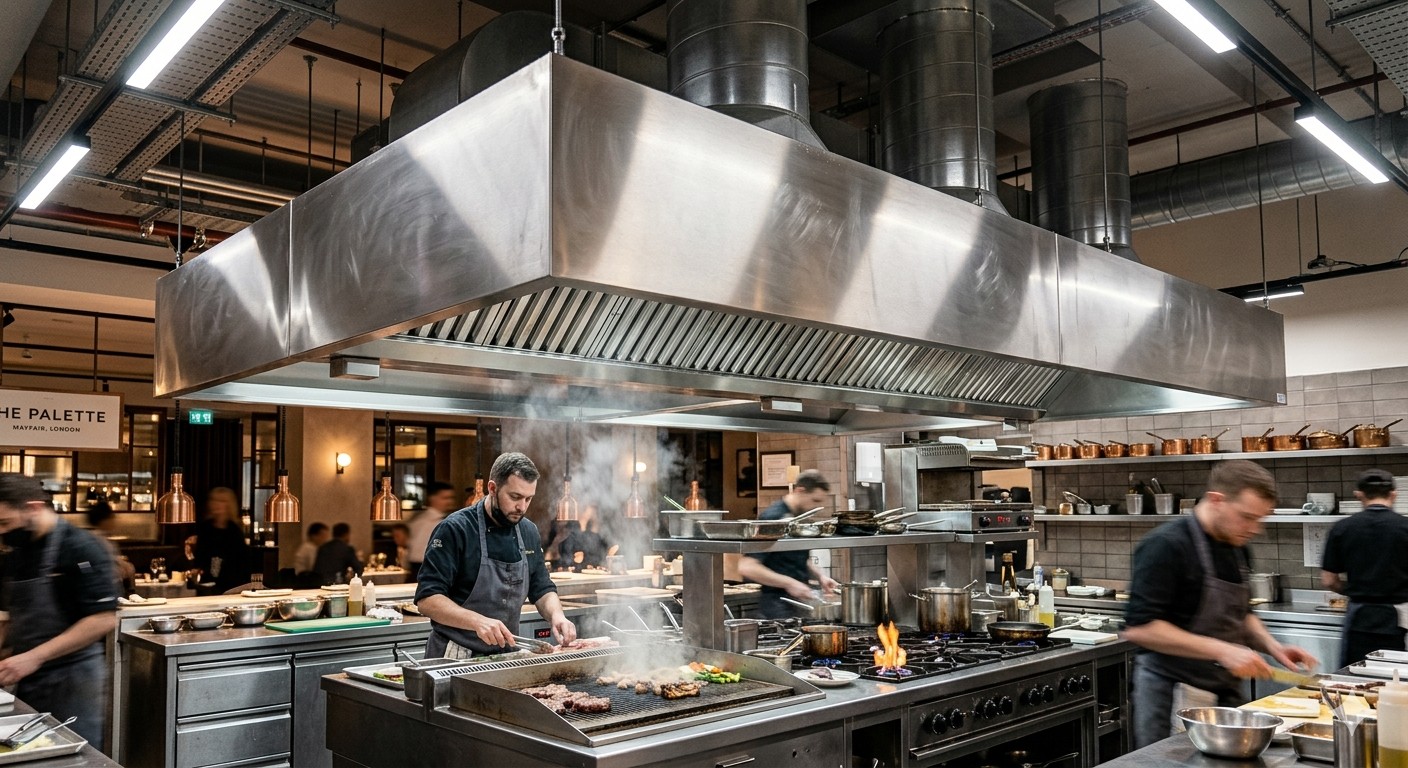
This is where a lot of people get caught out. They clean the visible filters – the mesh or baffle panels that slot into the canopy – and assume that’s job done. It isn’t. TR19 covers the entire system, which includes the canopy hood itself, all internal ductwork running through the building, the extract fan (including the motor housing and impeller blades), any grease collection vessels along the route, and the discharge point where air exits the building. That duct running through your ceiling cavity, the one you’ve never opened and can’t even see from the kitchen – that one counts too.
What Builds Up In There – And Why It’s So Dangerous
Cooking produces aerosols. Tiny particles of fat, moisture, and carbon travel upward with the heat and get drawn into the extraction system. Most of the heavier particles are caught by the filters, which is why regular filter cleaning matters. But a significant portion passes through and deposits itself on every internal surface between your canopy and the outside wall.
Over time, this builds into a layer of semi-solidified grease that coats the ductwork like a slow, sticky tide. In a busy kitchen, that layer can reach dangerous depths within weeks.
Why Grease In Ductwork Is A Uniquely Serious Fire Risk
Grease fires behave differently to other kitchen fires. They ignite at lower temperatures than you’d expect, they spread rapidly, and they are extraordinarily difficult to extinguish once established. A fire that starts in a duct has an immediate supply of fuel running the full length of the system, often into void spaces above suspended ceilings, through floor plates and across fire compartments.
The extraction fan – the thing designed to move air out of your kitchen – becomes a bellows the moment something ignites. I’ve spoken to fire investigators who described grease duct fires as essentially self-feeding. The fan keeps running, keeps pulling air, and the fire follows it right through the building. This is not a theoretical risk. It is the reason TR19 exists.
The Consequences Beyond Fire
Even without a fire, a grease-laden extraction system has practical consequences that hit your kitchen every day. Airflow decreases as deposits narrow the duct, which means heat, steam, and cooking odours build up in the kitchen faster than they should. That affects staff comfort, food quality, and the speed at which your kitchen can recover between services.
Blocked or restricted extraction also accelerates grease build-up on your cooking equipment – particularly on the underside of the canopy, where you’ll see that telltale brown drip pattern forming along the edges. It’s not aesthetic. It’s evidence of a system that isn’t keeping up with what your kitchen produces.
How TR19 Compliance Actually Works In Practice
The standard sets out cleaning frequencies based on the type and volume of cooking a kitchen produces. This is the part most restaurant owners have never seen laid out clearly.
The Four Risk Categories
TR19 divides kitchens into four usage levels – light, moderate, heavy, and very heavy – and assigns minimum cleaning frequencies accordingly.
Light use (under two hours of cooking per day) requires inspection and cleaning annually. Moderate use (two to six hours daily) requires cleaning every six months. Heavy use (six to twelve hours daily, which covers most full-service restaurants) requires quarterly cleaning. Very heavy use – solid cooking across extended hours, typical of high-volume operations – requires cleaning every month.
Those aren’t suggestions. They’re the minimum standard against which your fire insurer and any investigating authority will measure your conduct.
What A TR19-Compliant Clean Actually Involves
A compliant clean isn’t just sending someone up a ladder with a degreaser. It requires access to the full duct run, which often means cutting and reinstating access panels in the ductwork. Specialist contractors use a combination of chemical degreasers, mechanical agitation tools, and high-pressure equipment to remove deposits throughout the system – not just at the visible ends.
Crucially, the clean must be documented. A TR19-compliant contractor will provide a written report detailing the condition of the system before and after cleaning, the areas accessed, grease depth readings at key points, and a signed certificate confirming the work meets the standard. That certificate is what you produce when your insurer asks questions, or when an Environmental Health Officer wants to see your maintenance records.
What Happens When You Can’t Produce The Paperwork
This is the conversation nobody wants to have, so I’ll keep it brief and clear.
Your Insurance May Not Pay Out
Most commercial property and business interruption insurance policies contain clauses requiring the policyholder to maintain extraction systems in line with current standards. TR19 is that standard. If a fire starts in or spreads through your ductwork and you cannot show a cleaning certificate with an appropriate date, your insurer has grounds to reduce or refuse your claim entirely. I have known restaurant owners lose everything on this basis. It is not a hypothetical.
The Regulatory Consequences
Under the Regulatory Reform (Fire Safety) Order 2005, you are required to take reasonable steps to prevent fire and ensure the safety of anyone on your premises. Failure to maintain your extraction system – evidenced by the absence of TR19 documentation – can be used by the Fire Service or a court as evidence of negligence. Improvement notices, prohibition orders, fines, and in serious cases prosecution are all on the table.
Environmental Health Officers conducting food hygiene inspections are increasingly aware of extraction maintenance as a compliance marker. It’s not uncommon for them to ask about it during a visit. The absence of a cleaning certificate is the kind of thing that lingers in inspection notes.
Extraction canopy cleaning is one of those jobs that’s invisible when it’s done right and catastrophic when it isn’t. The grease doesn’t announce itself. The risk builds slowly, quietly, behind walls and above ceilings, until the day it doesn’t. Getting on top of TR19 compliance isn’t just paperwork – it’s the thing that keeps your kitchen, your staff, and your livelihood intact.