
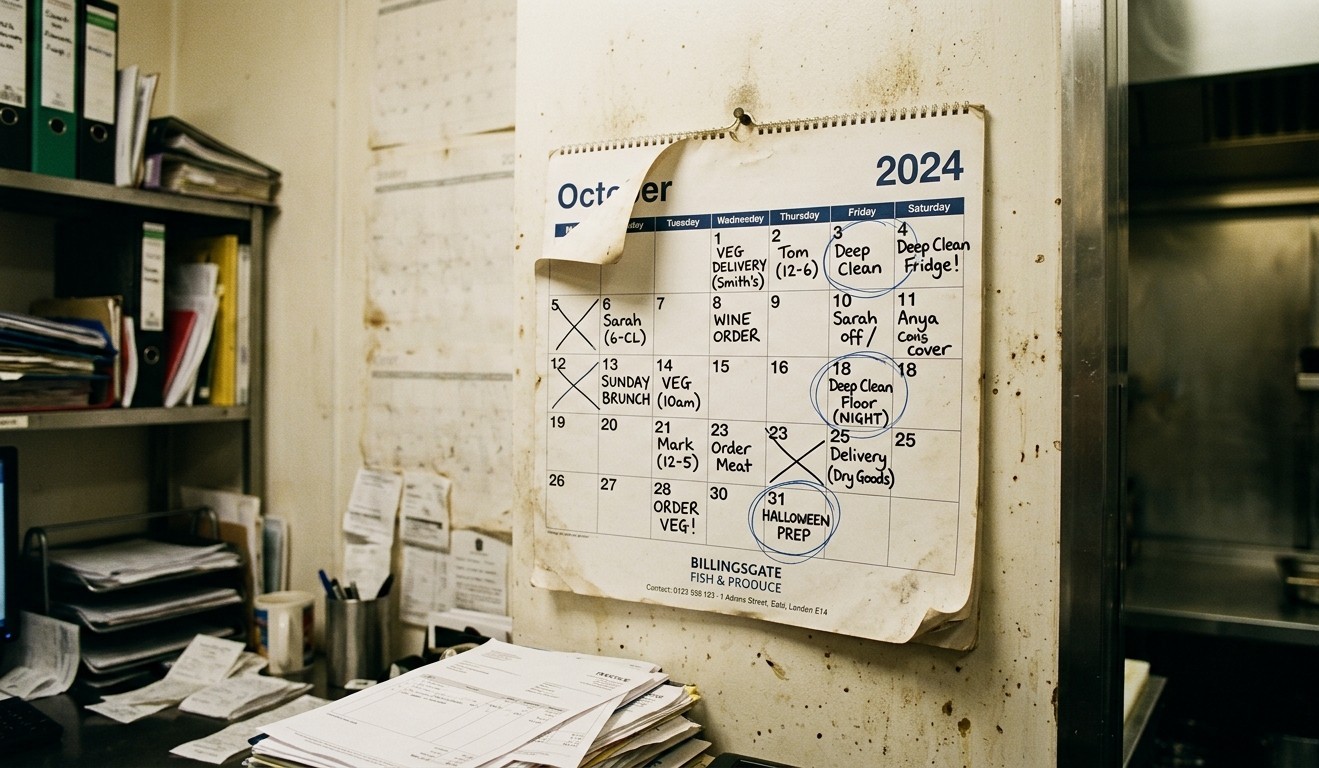
Most restaurant owners operate on instinct when it comes to deep cleaning. They schedule a professional clean when something starts to smell, when an inspection is looming, or when a member of staff raises the alarm about something nobody wants to look at too closely. It’s an understandable approach – kitchens are busy, margins are tight, and deep cleaning sits low on the list of things that feel urgent until they suddenly, urgently do.
The problem is that reactive cleaning is almost always more expensive, more disruptive, and less effective than a properly scheduled programme. And in a regulatory environment that is becoming progressively less tolerant of poor hygiene documentation, “we get someone in when it needs it” is not a position you want to be defending in front of an Environmental Health Officer.
This article sets out a practical framework for how often different elements of a commercial kitchen require professional attention, what drives those frequencies, and how to build a schedule that satisfies both operational and compliance requirements.
What “Professional Deep Clean” Actually Means
The term gets used loosely, which causes problems when restaurant owners try to budget for it or assess whether they’re doing enough. A professional deep clean is not an extension of your daily cleaning routine. It is a systematic intervention that addresses areas, equipment, and levels of contamination that in-house teams cannot realistically reach during normal operations.
The Distinction Between Maintenance Cleaning And Deep Cleaning
Maintenance cleaning – the daily and weekly tasks carried out by kitchen staff – keeps a kitchen functional and hygienic during service. It covers surface sanitisation, floor mopping, equipment wipe-downs, and the kind of routine attention that prevents immediate food safety hazards. It is essential, and without it no amount of professional intervention will keep a kitchen compliant.
Deep cleaning operates on a different axis entirely. It addresses the accumulation that maintenance cleaning cannot prevent: carbonised grease inside extraction ducts, biofilm on drainage infrastructure, residue behind and beneath fixed equipment, scale and organic build-up inside appliances, and microbial contamination in areas that are structurally difficult to access. These are not problems that develop overnight, and they are not problems that resolve with a mop and a spray bottle.
What A Professional Clean Should Actually Cover
A properly scoped professional deep clean of a commercial kitchen should include all cooking equipment, internal and external surfaces of extraction canopies and accessible ductwork, grease filters, all refrigeration units including door seals and internal drainage, floor drains and grease traps, wall and ceiling surfaces in the cooking area, and all fixed equipment moved to allow cleaning underneath and behind. Anything less than this is a partial clean, not a deep clean – which is worth clarifying with contractors before you agree a price.
How Frequency Is Determined
There is no single correct answer to how often a professional deep clean is required, because frequency depends on a set of variables that differ meaningfully between operations. The kitchen that needs monthly professional attention and the kitchen that can operate safely on a quarterly schedule are both legitimate – the difference lies in what and how much they cook, and how rigorously their in-house cleaning is maintained.
The Variables That Drive The Schedule
Cooking volume is the primary driver. A kitchen producing 200 covers per day generates significantly more grease, combustion residue, and organic contamination than one producing 60. High-volume operations accelerate build-up across every surface and system in the kitchen, compressing the time between professional interventions.
Cooking method matters almost as much as volume. Kitchens with heavy fryer use, char-grilling, or solid fuel cooking produce substantially more airborne grease than those focused on steaming, poaching, or oven cookery. The composition of the menu directly affects how quickly extraction systems, oven interiors, and drainage infrastructure reach the threshold that requires professional attention.
Kitchen age and infrastructure condition are also relevant factors. Older premises with less efficient extraction, worn seals on refrigeration units, or drainage systems that were not designed for commercial kitchen output may require more frequent professional intervention simply to maintain acceptable hygiene standards.
Finally, the quality and consistency of in-house maintenance cleaning determines how quickly professional-level build-up accumulates. A kitchen with disciplined daily cleaning routines will reach the intervention threshold more slowly than one where end-of-service cleaning is inconsistent.
A Practical Frequency Guide By Kitchen Type
The following is a working reference rather than a regulatory requirement, but it reflects industry consensus and aligns with the standards applied by most Environmental Health Officers and fire safety inspectors.
Light-use kitchens – cafés, sandwich bars, operations cooking for fewer than two hours daily – should schedule a full professional deep clean every six months as a minimum, with quarterly cleaning of extraction filters.
Moderate-use kitchens – mid-scale restaurants, pub kitchens, hotel dining operations cooking between two and six hours daily – require a full professional deep clean every three months, with monthly filter cleaning and six-monthly extraction duct inspection.
Heavy-use kitchens – full-service restaurants, catering operations, dark kitchens cooking between six and twelve hours daily – require professional deep cleaning every four to six weeks for high-output equipment such as fryers and grills, with a full kitchen deep clean every two months and monthly extraction system maintenance.
Very heavy-use operations – high-volume commercial kitchens running extended daily service across multiple cooking stations – should operate on a monthly full deep clean cycle, with extraction ductwork cleaned quarterly in line with TR19 requirements and grease trap servicing every four to six weeks.
Professional Versus In-House – Where The Line Sits
One of the most common mistakes in kitchen cleaning management is misallocating tasks between in-house staff and professional contractors. Both have a role. Understanding which tasks belong in which category prevents both under-investment in professional services and unnecessary expenditure on contractors for work that in-house teams can and should be handling.
What In-House Teams Can Realistically Handle
In-house kitchen teams, properly trained and equipped, can maintain surface cleanliness, daily and weekly equipment cleaning, refrigeration interior cleaning, drain basket and filter emptying, floor cleaning including grout scrubbing on a weekly cycle, and oven interior wipe-downs between deep cleans. These tasks collectively represent the majority of daily cleaning activity and are entirely within the capability of a well-managed kitchen team.
The ceiling on in-house cleaning is defined by access and equipment. Kitchen staff cannot safely access extraction ductwork, cannot service the mechanical components of extraction fans, cannot professionally clean grease interceptors without specialist equipment and licensed waste carrier documentation, and should not be attempting to deep clean behind large fixed appliances without appropriate training and risk assessment.
What Requires Specialist Contractors
Professional contractors bring three things that in-house teams cannot replicate: specialist equipment, hazardous waste handling credentials, and the documentation that compliance requires.
Extraction duct cleaning requires access equipment, specialist rotary brush systems, and the ability to cut and reinstate access panels in ductwork. TR19-compliant contractors carry the insurance and certification that gives their cleaning certificates legal standing. Using an uncertified contractor to clean your ductwork does not produce a valid TR19 certificate, regardless of the quality of the work.
Grease trap servicing requires a registered waste carrier licence to remove and dispose of the collected material legally. Using an unlicensed individual to empty a grease trap creates environmental liability and produces no defensible compliance record. The waste transfer note issued by a licensed contractor is the document that demonstrates legal disposal – without it, you have no evidence that the waste was handled appropriately.
Deep cleaning of commercial refrigeration systems, including coil cleaning and condenser maintenance, is a task requiring refrigeration engineering knowledge alongside cleaning expertise. It sits at the intersection of hygiene and equipment maintenance, and mistakes can affect the performance of units that are critical to food safety.
Building A Schedule That Holds Up
A cleaning schedule that exists only in someone’s head is not a schedule – it’s an intention. The distinction matters when an EHO asks to see your cleaning records, when your insurer queries your extraction maintenance history, or when you’re trying to diagnose why a piece of equipment is performing below expectations.
Structuring Your Annual Cleaning Plan
A practical approach is to map out the full year at the start, assigning professional deep clean dates for each element of the kitchen based on the frequency appropriate to your operation. Work backwards from any known regulatory touchpoints – if your premises licence comes up for review in October, ensure a full professional deep clean has been completed within the preceding three months.
Build in contingency. Contractor availability, equipment breakdowns, and service closures will occasionally disrupt a planned clean. A schedule with no flexibility tends to slip indefinitely once it falls behind. Build in at least one additional clean per year beyond your calculated minimum, which gives you a buffer without compromising your compliance position.
Coordinate extraction duct cleaning with your insurer’s requirements as well as TR19 frequencies. Some commercial kitchen insurance policies specify cleaning intervals as a condition of cover. Check your policy documentation and ensure your schedule meets or exceeds whatever threshold applies.
Documentation And Compliance Records
Every professional clean should generate paperwork. Contractor invoices alone are not sufficient – you need signed service reports detailing the scope of work completed, the condition of the areas cleaned, and any issues identified that require follow-up. For extraction cleaning, this means a TR19-compliant certificate. For grease trap servicing, this means a waste transfer note. For general deep cleans, a dated scope-of-work report from the contractor.
Keep these records for a minimum of three years and store them somewhere accessible. An EHO asking to see your cleaning history during an unannounced inspection is not a situation that benefits from a twenty-minute search through a filing cabinet.
Cleaning frequency is ultimately a risk management question. The costs of insufficient professional cleaning – regulatory action, insurance exposure, equipment damage, and the compounding expense of remediation work – are consistently higher than the cost of a properly structured maintenance programme. The numbers, when laid out clearly, tend to make the decision straightforward.