
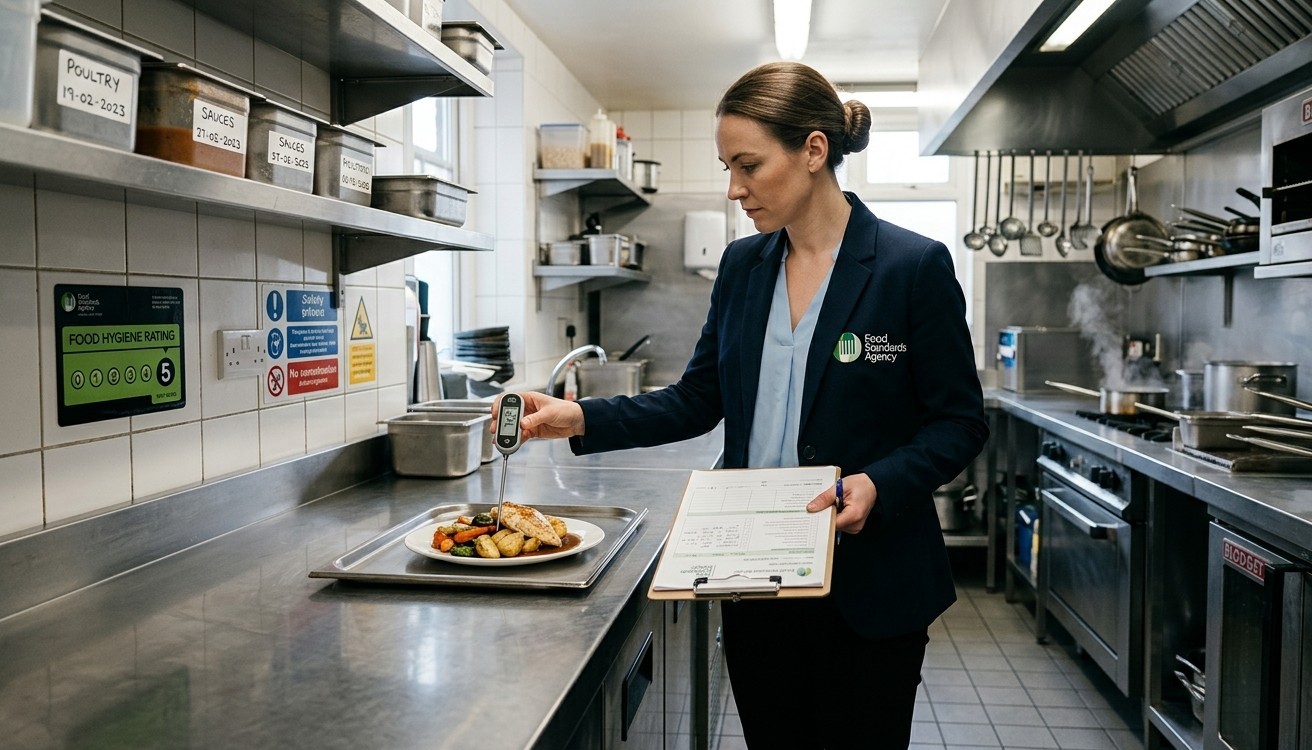
There’s a particular type of text message that sends a restaurant owner into a cold sweat. Not the one from a supplier saying the delivery’s running late, and not the one from your head chef saying they’ve come down with something suspicious the morning of a private hire. No – the worst one is the innocuous little notification from your local council informing you that an Environmental Health Officer will be visiting your premises in the near future.
I’ve watched otherwise unflappable restaurant owners completely unravel at the mention of a hygiene inspection. One bloke in Islington – runs a lovely modern Greek place, genuinely spotless front of house – rang me in a state of mild panic asking if I could come in that same evening. He’d had the notification that morning. The inspection was scheduled for the following week. He was convinced they were going to find something terrible. They didn’t, as it happens. He got a four, lost a point on documentation, and spent the next month muttering about it.
The thing is, food hygiene inspections are far less mysterious than people think. Environmental Health Officers aren’t hunting for reasons to fail you. They’re working through a structured assessment against published criteria. Once you understand what they’re actually looking at – and why – the whole process becomes a great deal less frightening and a great deal more manageable.
What The Inspection Actually Is – And Who’s Doing It
Environmental Health Officers are employed by your local authority and carry the power to inspect food businesses without prior notice, though in practice many inspections do come with some warning. They’re assessing your premises against the Food Hygiene Rating Scheme, which is administered by the Food Standards Agency and produces the 0-to-5 score you see displayed in restaurant windows and on Just Eat listings across the country.
The scheme is mandatory for all food businesses in England, Wales, and Northern Ireland, and while displaying your rating isn’t currently a legal requirement in England, it absolutely is in Wales – and the reputational weight of the score applies everywhere regardless. A two-star rating visible on a delivery app is doing your bookings no favours.
The Three Pillars Of Every EHO Assessment
Every inspection scores you across three areas. First, hygienic food handling – how food is prepared, cooked, reheated, cooled, and stored, and whether the processes in your kitchen prevent contamination. Second, cleanliness and condition of the premises – the physical state of your kitchen, equipment, and facilities. Third, management of food safety – whether you have adequate systems in place to identify and control risks, and whether your staff understand and follow them.
Each of these carries roughly equal weight in the final score, which is an important point many restaurant owners miss. You can have an immaculate kitchen and still score poorly if your food safety management documentation is a shambles.
How The Score Is Calculated
The EHO doesn’t simply add up points and hand you a number. The scoring system identifies the lowest level achieved across the three areas and uses that as the ceiling for your overall rating. This means a single weak area pulls your entire score down, regardless of how well you perform elsewhere. A kitchen that scores brilliantly on physical cleanliness but has no documented food safety procedures in place will not receive a five. Understanding this is the key to understanding where to focus your energy.
What They Notice The Moment They Walk In
Here’s something I always tell restaurant owners: the inspection begins before the EHO has said a word to you. The moment they step through your door, they’re forming impressions that will colour everything that follows. Not consciously, not unfairly – but practically. It’s human nature, and EHOs are humans.
A kitchen that feels clean, organised, and well-run creates a positive baseline. A kitchen that smells of yesterday’s service, has food debris on the floor near the entrance, or has staff visibly confused about who’s responsible for what – that creates a very different starting point.
The First Few Minutes
Inspectors tend to start with a general walkthrough before getting into specifics. They’re looking at overall organisation, the condition of surfaces and equipment, whether cleaning schedules are visibly posted, and how staff behave when they realise an inspection is underway. Panic is noted. Calm, confident familiarity with procedures is also noted, and in a much more positive way.
Handwashing facilities get attention very early. Are the designated handwashing sinks clear and accessible? Is there soap and disposable towels available? Are they being used? This is a basic legal requirement under food hygiene regulations, and an EHO who finds a handwashing sink being used for food prep or stacked with equipment is already reaching for their clipboard with purpose.
The Documentation They Want To See
This is where many otherwise well-run kitchens lose points unnecessarily. Your Hazard Analysis and Critical Control Points (HACCP) documentation needs to be current, coherent, and accessible. This means your food safety management system – whether it’s a proprietary system like Safer Food Better Business or a bespoke document – should reflect what your kitchen actually does, not what it did when you first opened three years ago.
Temperature logs matter. Cleaning schedules matter. Allergen records matter. Delivery records matter. If you’ve been keeping them consistently, producing them confidently during an inspection takes thirty seconds. If you haven’t, no amount of sparkling stainless steel will fully compensate for the gap.
The Areas That Catch Kitchens Out Most Often
After years of cleaning commercial kitchens and speaking to the owners and managers who run them, certain patterns emerge. The same areas come up again and again as the ones that drag scores down – not because they’re difficult to maintain, but because they’re easy to overlook during the controlled chaos of daily service.
Temperature Control And Cold Storage
Improper temperature control is one of the most common reasons food businesses receive lower ratings. Food that should be below 8°C sitting at 12°C, hot-held food not being maintained above 63°C, cooked food being cooled too slowly before refrigeration – these are the kinds of issues that EHOs find routinely and that carry serious food safety implications.
Your fridge and freezer temperatures should be logged twice daily at minimum, and those logs should be retained. Probes used to check food temperatures need to be cleaned and calibrated. If your cold storage units are struggling to maintain temperature – which often happens when they’re overloaded, poorly positioned, or have compromised door seals – that needs addressing before it becomes an inspection issue.
Cross-Contamination Controls
Raw meat stored above ready-to-eat food in a refrigerator is a finding that inspectors encounter so regularly it has become almost a cliché of food hygiene visits – and yet it keeps happening. The controls around cross-contamination are some of the most fundamental in food safety, and demonstrating that your kitchen takes them seriously matters considerably.
Colour-coded chopping boards and utensils should be in active use and in good condition – not present in a drawer somewhere while staff use whatever comes to hand. Separate storage for allergen-containing ingredients needs to be clearly organised and understood by everyone working in the kitchen. Surface cleaning between tasks, particularly when switching between raw proteins and other ingredients, should be second nature rather than something that happens when someone remembers.
How To Prepare Without Losing Your Mind
The most important thing I can tell you about food hygiene inspection preparation is this: the best time to prepare is not the week before the inspection. It’s every week, every month, every service. An EHO isn’t inspecting your kitchen on its best behaviour – they’re assessing the systems and habits that determine how it runs when nobody official is watching.
The Ongoing Habits That Actually Move The Needle
Consistent temperature logging, dated cleaning schedules that are actually followed, staff who understand the food safety procedures they’re working within – these are the habits that produce five-star results. None of them require a frantic deep clean the night before an inspection. They require a culture in which food safety is taken seriously as a daily operational standard rather than a compliance exercise.
Regular internal audits – walking your own kitchen with the same critical eye an EHO would bring – are underused and enormously valuable. Walk in cold, look at what’s actually on surfaces and floors and shelves, and ask yourself honestly whether you’d be comfortable with a stranger writing it all down. If the answer is yes, you’re in good shape.
If Your Score Isn’t What You Were Hoping For
A score below five isn’t the end of the world, and it isn’t necessarily a reflection of a dirty or dangerous kitchen. It may reflect documentation gaps, a temperature log that lapsed during a busy period, or a structural issue with the premises that requires time and investment to resolve properly. The EHO will provide a written report detailing the specific areas where improvement is needed, and that document is genuinely useful. Read it carefully, address each point methodically, and request a re-inspection once you’re confident the issues have been resolved.
Scores can be appealed if you believe the assessment was inaccurate, and re-inspections – while not automatic – are available to businesses that have made demonstrable improvements.
A five-star food hygiene rating is not a reward for having an expensive kitchen or a large cleaning budget. It’s a reflection of consistent, well-documented, well-understood food safety practice across everything your kitchen does. The restaurants that achieve it reliably aren’t necessarily the ones with the shiniest equipment – they’re the ones where everyone, from the head chef to the newest kitchen porter, knows what the standards are and why they exist.
That’s the part no deep clean can substitute for. But it’s also the part entirely within your control.